Prompt engineering tools are no longer just places to write clever instructions. The category moved from informal experimentation after GPT-3 appeared in 2020 to a recognized software discipline after ChatGPT's 2022 launch, with prompts increasingly versioned, tested, shared, and deployed as operational assets. Atlan's overview of prompt engineering describes how the practice expanded into tool-enabled workflows, and market estimates now place the surrounding tools category in the hundreds of millions of dollars, with one forecast projecting USD 3.80 billion by 2034. The Intelevore market report treats that figure as a projection, not a settled measure of current revenue.
That growth creates a practical buying problem. A prompt library, an evaluation framework, an observability gateway, and a first-party model console solve different problems. There isn't one universal winner.
This list organizes 11 prompt engineering tools by the job they perform in a prompt workflow. Compare them by team size, model-provider mix, code-first versus UI-first work, self-hosting requirements, governance, evaluation depth, and operational maturity. The selection includes first-party consoles, open-source frameworks, creative discovery platforms, and broader LLMOps products.
A practical comparison lens
- Draft and discover: Find patterns, test ideas, and shorten the learning curve.
- Evaluate and optimize: Compare prompts, models, datasets, graders, and failure modes.
- Release and govern: Version prompts, assign ownership, manage environments, and roll back safely.
- Observe and operate: Trace requests, understand latency and cost, and control production behavior.
- Choose for fit: Balance provider lock-in, implementation effort, deployment model, and team workflow.
Founders preparing to present an AI product to early adopters may also find EarlyHunt useful for focused launch discovery. It isn't a substitute for the engineering tools below. It addresses product visibility, not prompt testing or LLM operations.
1. PromptHero
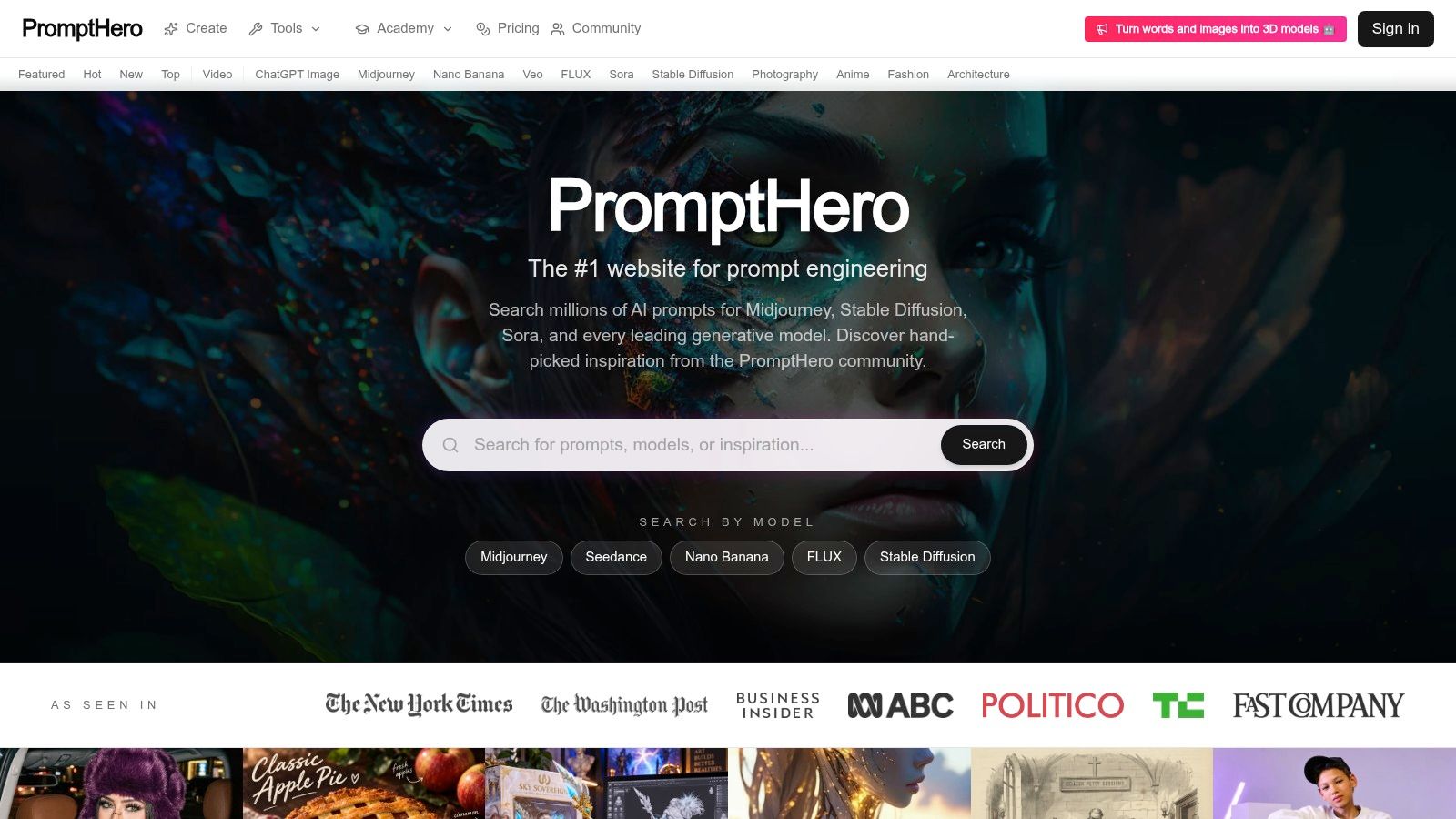
PromptHero is best understood as a discovery and learning platform for generative AI prompts, especially prompts for image and video creation. It indexes and organizes examples associated with tools such as Midjourney, Stable Diffusion, FLUX, Sora, Veo, ChatGPT Image, Seedance, and Nano Banana, giving creative teams a place to inspect how other people structure prompts and parameters.
That distinction matters. PromptHero isn't an enterprise prompt registry, CI/CD evaluator, or production tracing layer. Its value comes earlier in the lifecycle, when a designer, marketer, founder, or creative technologist needs useful starting points rather than an empty text box.
Discovery with context
The catalog supports model-specific collections, themed categories, example outputs, visible parameters, and browsing modes such as Featured, Hot, New, and Top. Those signals help users move from vague inspiration to a prompt they can adapt. Photography, anime, fashion, architecture, and video prompts have different conventions, so a taxonomy organized around media and use case is more helpful than a single undifferentiated search page.
Community profiles and engagement signals add another layer. A prompt with an example output and model context is easier to reproduce than a short instruction copied from an anonymous list. The Academy and related educational resources also make PromptHero useful for people who are still learning how image and video models interpret style, composition, subject, and parameters.
Practical rule: Use a community prompt as a hypothesis, not as a guaranteed production recipe. Recreate it with the same model and settings where possible, then test variations against your own brief.
The platform also includes a models directory, related assets such as checkpoints, LoRA, and ControlNet, plus lightweight creative generators for quick experimentation. That breadth reduces the need to search across disconnected communities, although it can also encourage browsing instead of disciplined evaluation.
Where PromptHero fits
Choose PromptHero's prompt engineering tools when your bottleneck is prompt discovery, creative reference, or model-specific learning. It's particularly suitable for image and video teams, educators, independent creators, and product teams exploring visual concepts before building a repeatable pipeline.
It isn't the right primary choice when you need production traces, role-based approval, automated regression tests, or neutral evaluation across business-critical workflows. For those jobs, pair discovery with a testing or LLMOps platform rather than asking a community catalog to manage operational risk.
2. LangSmith
LangSmith is a broad LLM application platform for teams that need prompt experiments, datasets, evaluations, deployments, and detailed traces in one workflow. It's especially compelling when a team already works with LangChain or LangGraph, although its usefulness isn't limited to those ecosystems.
The strongest feature is the connection between what happened in production and what gets tested next. A team can inspect a chain or agent trace, capture representative inputs and outputs in a dataset, compare prompt or model variants, and use graders to inform a release decision. That closes the loop between experimentation and operations more effectively than a standalone playground.
Deep observability with more planning
LangSmith supports rich trace metadata, offline and online evaluation patterns, LLM-as-judge graders, and deployment options that include cloud, hybrid, and self-hosted arrangements. US and EU data residency options can help teams with regional handling requirements, but buyers still need to verify the exact controls available to their plan and deployment.
The trade-off is platform breadth. Cost forecasting uses LangChain's LCU and LSU concepts, which can give teams a clearer metering vocabulary but adds work during budget planning. Advanced evaluator availability may also depend on plan or region, so procurement should confirm access before designing a workflow around a specific capability.
For teams evaluating a product discovery layer alongside engineering infrastructure, the EarlyHunt prompt builder project is a separate launch-oriented resource, not a replacement for LangSmith's tracing and evaluation stack.
Best fit
Use LangSmith when you need mature tracing and evaluation together, particularly across chains, agents, datasets, and release experiments. It may be more platform than a solo developer needs, but that complexity becomes useful when multiple engineers need a shared record of prompt behavior and production failures.
3. Humanloop
Humanloop is designed for organizations where prompt work crosses engineering, product, operations, and compliance teams. Its UI-first workspace gives non-engineers a practical place to edit and compare prompts, while code and CI/CD integrations let developers connect approved versions to applications.
That shared workflow is the product's central advantage. A product manager can review prompt variants, an operations team can capture user feedback, and an engineer can connect tagged deployments and evaluation results to a release process. Logging, tracing, production alerts, datasets, and reports give the workflow continuity after deployment.
Collaboration is the deciding factor
Humanloop supports multi-LLM experimentation, version history, tagged deployments, offline and online evaluators, and feedback capture. Enterprise deployment options include VPC and EU or US hosting, while compliance features include SOC2 and GDPR options, with HIPAA available through business associate agreements.
The platform's strength can become unnecessary overhead for a single developer trying to improve one prompt. Public pricing is limited, and planning for larger usage or advanced requirements may require sales engagement. That isn't automatically a disadvantage, but it means teams should define the users, environments, data controls, and evaluation volume they need before comparing plans.
A good implementation starts with ownership. Assign a person or team to each prompt family, define which tags represent development and production, and require evaluation evidence before changing a production deployment. Humanloop gives you the workflow surface, but governance still depends on internal rules.
Best fit
Choose Humanloop when several roles need to collaborate around prompts and the organization values deployment controls, feedback loops, and enterprise hosting. Solo builders and small teams with minimal governance needs may find a lighter open-source toolkit easier to operate.
4. Promptfoo
Promptfoo treats prompt engineering as a testing and security problem. Its open-source toolkit can run locally or in self-hosted environments, compare prompt and model variants, support automated evaluations, and integrate with CI/CD pipelines. That makes it a strong choice when a prompt change should behave like a code change, complete with regression checks.
A practical workflow is straightforward. Define representative test cases, run competing prompts or providers, inspect quality and security failures, and stop a release when results fall below the team's chosen threshold. The important point isn't the existence of a dashboard. It's the ability to make evaluation part of the release path instead of relying on a developer's manual spot check.
Testing and red-teaming
Promptfoo also supports red-teaming, vulnerability scanning, guardrails, continuous monitoring options, webhooks, and broad provider coverage. The open-source path reduces initial vendor lock-in and gives developers more control over where sensitive test data runs.
Commercial boundaries still matter. Some enterprise capabilities require a paid license, and red-team probe capacity can be limited on the free tier. Teams should also budget time to maintain test cases. A test suite that only covers ideal inputs will miss the failures that matter most in production.
A passing prompt test is evidence about the cases you wrote. It isn't proof that the model will behave safely on every unseen input.
Use Promptfoo when you need open testing, automated regression checks, and security-oriented evaluation. It pairs well with an observability platform because testing tells you whether a candidate is acceptable, while tracing shows what real users experienced. For a lightweight starting point, teams can also inspect the free AI prompt optimizer project, while keeping production validation in Promptfoo.
5. Helicone
Helicone is a practical observability and gateway layer for teams that want visibility into prompts and outputs without rebuilding their application architecture. Its proxy integration can route requests through a logging and analytics layer, making it a relatively fast way to inspect usage across providers such as OpenAI, Anthropic, and Azure.
The proxy is useful for more than debugging. Teams can analyze request patterns with HQL, create alerts and reports, and use gateway features such as caching, rate limits, and fallbacks. Those controls help connect prompt decisions to operational concerns. A prompt that looks good in a playground may still be too slow, too expensive, or too unreliable in a live application.
Fast setup, variable operating cost
Helicone includes prompt management, a playground, dataset-based testing, multi-provider integrations, and compliance options. Its startup-friendly pricing approach can lower the barrier to adoption, but usage-based components may make monthly costs less predictable as traffic changes. Advanced governance is concentrated primarily in higher tiers, so security and access requirements should be checked early.
The implementation pattern is simple. Add the proxy, label important requests, inspect traces and failure clusters, then use HQL to identify anomalies or expensive paths. After that, introduce caching or fallbacks only where they preserve response quality. Gateway controls can reduce operational pain, but they shouldn't hide a poor prompt or an unsuitable model.
Best fit
Select Helicone when the immediate bottleneck is production visibility, cost analysis, latency debugging, or gateway control. It's less suitable as the sole system for complex prompt governance or deep offline experimentation, where a dedicated evaluation platform may provide stronger structure.
6. Langfuse
Langfuse combines prompt management, tracing, evaluations, metrics, datasets, and a playground with an emphasis on open-source deployment. The key design choice is to decouple prompts from application code. An application can fetch a labeled prompt at runtime, while the team manages versions and release labels centrally.
That pattern makes rollback easier. Instead of changing a prompt string inside a code deployment, a team can promote a tested revision, observe its traces and scores, and return to an earlier label if behavior deteriorates. Client-side and server-side caching also support prompt retrieval without turning every request into a configuration bottleneck.
Open control with operational responsibility
Langfuse supports custom scores, online and offline evaluations, public APIs and SDKs, cloud hosting, and self-hosting. Transparent plan information can make early planning easier than products whose pricing is mostly sales-led. The open-source option also limits dependence on one vendor's hosted environment.
Self-hosting isn't free from responsibility. The team must operate storage, upgrades, access controls, backups, and monitoring. Cloud plans may also place some enterprise features behind add-ons. The right question isn't just whether self-hosting is possible. It's whether the organization has a reason and the operational capacity to own that layer.
A sensible setup starts with a small set of production prompts. Give each one a clear owner, define labels such as test and production, attach evaluation datasets, and record changes in version history. That creates release discipline without forcing the entire application into a new framework.
Best fit
Use Langfuse when open-source prompt management, tracing, and release control matter more than a fully managed enterprise experience. It's a strong middle ground for engineering-led teams that want cloud convenience but need a credible self-hosting path.
7. Agenta
Agenta focuses on prompt registries, environments, deployment, and multi-model testing. Its built-in playground stores model settings with prompt variants, which helps prevent a common source of confusion: comparing prompt text while unknowingly changing temperature, model, or other configuration.
The registry approach turns prompt changes into reviewable revisions. An engineer can use the SDK or API to fetch a known version at runtime, commit a new revision, and promote it through environment labels. That is more reliable than leaving prompt edits scattered across application files, notebooks, and team chat.
A developer-friendly release path
Agenta offers open-source deployment alongside a cloud service, with APIs and SDKs suited to CI hooks and application integration. Multiple providers and frameworks make it less tied to one model vendor than a first-party console. The built-in playground is useful for testing variants before moving them into a controlled environment.
Cloud pricing can vary by tier and may require outreach for discounts. The ecosystem is also younger than larger incumbents such as LangChain and LangSmith. That doesn't make it a poor choice, but teams should assess documentation, integrations, support expectations, and the ability to export or migrate prompt assets before committing.
Store the model configuration beside the prompt. Otherwise, your team may attribute a quality change to wording when the real cause is a different model setting.
Choose Agenta when you want open-source prompt management with a cloud option and CI/CD-style release control. It suits developer-led teams that want more structure than a playground but less platform breadth than a large LLMOps suite.
8. OpenAI Playground and Evals
OpenAI Playground is the lowest-friction choice for teams already building primarily with OpenAI models. It provides a first-party environment for prompt templates, variables, presets, and version history, while OpenAI's Evals guidance and cookbook examples show how to create graders, test cases, and bulk comparisons.
The workflow is efficient for early and middle-stage iteration. Draft a template, insert variables, compare prompt or model variants, create representative cases, and connect the result to the Responses API or Agents SDK. First-party documentation also tends to track the provider's current interfaces more closely than an external abstraction layer.
Convenience has a boundary
The main trade-off is provider specificity. If the application may switch between OpenAI, Anthropic, open models, or multiple hosted providers, the Playground won't give you a neutral evaluation environment. Collaboration and governance features are also thinner than those found in dedicated LLMOps platforms.
That doesn't make the tool unsuitable for serious work. A team can use it to establish prompt patterns and evaluation habits before adopting a broader system. It's especially useful when the main need is fast iteration with one provider rather than cross-provider governance.
Teams exploring a simple generation aid can also review the AI prompt generator project, but generated drafts still need test cases and application-specific evaluation.
Best fit
Use the OpenAI Playground when OpenAI is the center of your stack and you want canonical tooling with minimal setup. Move to a provider-neutral platform when model comparison, portability, or shared enterprise governance becomes important.
9. Anthropic Console
Anthropic's Console, including Workbench functionality, gives Claude-focused teams a compact workflow for prompt design and evaluation. Users can create shareable prompts, generate test cases, compare outputs, grade quality, refine instructions, and obtain deployment code without stitching together several external tools.
The strongest use case is a team that wants to learn quickly while staying close to Claude's current capabilities. Automatic test-case generation can help turn a vague prompt experiment into a more representative evaluation set, while side-by-side comparisons make differences easier to inspect. Usage and cost reporting in Console accounts adds operational context during iteration.
A strong Claude workflow, not a neutral lab
A practical sequence is to define the task and success criteria, create a shareable prompt, generate cases that include difficult inputs, compare versions, record quality judgments, and use the refinement tools only after identifying the actual failure pattern. That last step matters. Automatic refinement can produce a cleaner instruction, but it doesn't replace a human decision about what the application should do.
The limitation is provider scope. Anthropic's environment is naturally centered on Claude, so teams comparing several providers or managing organization-wide prompt governance may need an external evaluation and registry layer. API and model token pricing also varies by model, which should be considered separately from the Console workflow.
Best fit
Choose the Anthropic Console when Claude is your primary model family and you want integrated prompt testing with little setup. It's less appropriate as the only evaluation environment for a multi-provider application.
10. Azure AI Studio Prompt flow
Azure AI Studio Prompt flow combines prompts, tools, and Python code into flows that teams can trace, evaluate against datasets, and connect to Azure development workflows. It fits organizations that already depend on Azure security, compliance, DevOps, RAG, agent pipelines, SDKs, CLI tools, or the VS Code extension.
The platform's deployment model can be attractive for teams that need local and cloud development within one ecosystem. Engineers can develop through SDK and VS Code workflows, then connect structured evaluations and tracing to Azure services. That integration reduces friction when the application's identity, data, and deployment controls already live in Microsoft's cloud.
Treat the timeline as a migration decision
Prompt flow feature development ended on April 20, 2026, and the feature is scheduled to retire on April 20, 2027, according to the Prompt flow documentation. That makes lifecycle planning more important than a simple feature checklist. Teams adopting or maintaining it should identify replacement services, inventory flows and datasets, and test how much code and configuration can move elsewhere.
Azure-centric design can also limit portability across clouds. For an existing Azure estate, that may be an acceptable short-term trade-off. For a new application seeking provider neutrality, it creates future migration work from the beginning.
Best fit
Use Azure AI Studio Prompt flow only when Azure integration solves an immediate architectural need and you have a migration plan. Don't select it solely because its current authoring and evaluation features look convenient. The retirement timeline changes the total cost and risk of adoption.
11. DSPy
DSPy takes a different approach from visual prompt workbenches. Instead of manually polishing a prompt until the output looks better, developers define modules, data, and metrics, then let the framework compile and optimize prompt behavior against those signals.
That makes DSPy closer to programming and experimentation than prompt editing. A developer might define a retrieval-and-answering pipeline, specify what counts as a good result, run optimization over a dataset, and inspect how the resulting program performs. The method is useful when the team can express quality criteria clearly and has representative examples available.
Systematic optimization over manual tweaking
DSPy supports declarative pipelines, automatic prompt and parameter search, common model-provider integrations, and research-oriented optimization methods. Its open-source model reduces vendor lock-in and encourages reproducible experiments. The trade-off is usability. Python proficiency and an experimentation mindset are important, while non-developers may find the lack of a conventional GUI limiting.
DSPy also doesn't replace every other layer. It can help create a better prompt program, but teams still need a way to version deployments, observe production traces, manage access, and respond to regressions. Pairing it with an evaluation or observability platform can separate optimization from operations.
A strong starting point is a narrow task with a measurable rubric and a clean dataset. Define failure categories before optimization, keep a holdout set for checking generalization, and inspect individual outputs instead of trusting a single aggregate score. The framework is most valuable when it replaces guesswork with repeatable experiments.
Best fit
Choose DSPy on GitHub when dataset-driven optimization is the core problem and your team is comfortable treating prompts as part of a programmable system. Choose a GUI-first platform instead when the main users are product, content, or operations specialists.
Top 11 Prompt Engineering Tools Comparison
| Product | Core features | ✨ Unique strengths / 🏆 | ★ UX & reliability | 👥 Target audience | 💰 Pricing/value |
|---|---|---|---|---|---|
| PromptHero | Searchable multi-model prompt catalog, themed collections, creative generators | Massive prompt library + Academy, built-in creative tools ✨🏆 | ★★★★, intuitive discovery, community curation | Creators, prompt engineers, artists 👥 | Free tier + subscriptions; accessible 💰 |
| LangSmith (by LangChain) | Experiment tracking, traces, evaluations, datasets, deployments | Integrated observability + evals for LLM apps ✨🏆 | ★★★★, mature tooling, strong docs & integrations | Advanced ML/ops teams and SREs 👥 | Commercial; metered (LCU/LSU), forecasting complexity 💰 |
| Humanloop | Prompt management, versioning, evaluators, logging/tracing | UI-first enterprise workflows, role-based collaboration ✨ | ★★★★, polished UI, production-grade controls | Product, ops, engineering teams in enterprise 👥 | Enterprise pricing; sales-led tiers 💰 |
| Promptfoo | Open-source prompt testing, red‑teaming, CI/CD integrations | OSS + CI automation, security-focused testing ✨🏆 | ★★★★, developer-centric, reliable in pipelines | Devs, security teams, CI/CD pipelines 👥 | Free OSS; commercial plans for enterprise features 💰 |
| Helicone | Proxy logging, HQL analytics, gateway (caching/rate limits) | One-line proxy for fast observability & gateway controls ✨ | ★★★★, quick setup; strong analytics, usage variance | Teams needing cost/latency visibility & ops controls 👥 | Usage-based pricing; startup discounts available 💰 |
| Langfuse | Prompt versioning, caching, experiments, self-host/cloud | Open-source, performance-oriented prompt fetching ✨🏆 | ★★★★, transparent plans; self-host ops trade-offs | Teams avoiding vendor lock-in, performance-focused 👥 | OSS + cloud tiers; predictable paid plans 💰 |
| Agenta | Prompt registry, env labels, SDK/API, playground | CI/CD-style prompt releases and environment controls ✨ | ★★★, developer-friendly; younger ecosystem | Dev teams wanting reviewable prompt releases 👥 | Open-source + cloud; pricing varies by tier 💰 |
| OpenAI Playground + Evals | Playground templates, variables, evals, graders | First‑party, canonical OpenAI tooling for prompts ✨🏆 | ★★★★, low friction for OpenAI users | Teams centered on OpenAI models, fast iteration 👥 | Usage-based OpenAI billing; straightforward 💰 |
| Anthropic Console (Claude) | Shareable prompts, test suites, prompt refiner, reporting | Tight Claude model integration and built-in eval loops ✨ | ★★★★, enterprise console, integrated workflows | Teams building primarily on Claude 👥 | Vendor pricing; model usage fees apply 💰 |
| Azure AI Studio – Prompt flow | Flow authoring (prompts+tools+Python), tracing, SDK/CLI | Deep Azure/DevOps fit for RAG/agent pipelines ✨ | ★★★, capable but feature retiring; migration needed | Azure-centric enterprises (short-term fit) 👥 | Azure billing; retirement risk impacts value 💰 |
| DSPy (Stanford) | Declarative prompt pipelines, automatic optimization, metrics | Research-backed programmatic prompt optimization ✨🏆 | ★★★★, powerful for Python devs; non-GUI | Researchers, ML engineers with Python expertise 👥 | Free, open-source (research/community) 💰 |
Build a Stack That Matches Your Workflow
The right choice depends less on which tool has the longest feature list and more on where your workflow currently breaks. Prompt drafting, evaluation, release control, and production observation are different jobs. A small team may combine them in one provider console, while a mature application may need a deliberately separated stack.
For fast, provider-specific iteration, start with a first-party console. OpenAI Playground and Anthropic Console reduce setup friction and provide guidance close to their respective models. They're useful when one provider dominates your application and you need to move from an idea to a tested prompt quickly. Their limits appear when you need neutral comparisons, shared governance, or portability across providers.
For open testing and CI/CD security checks, Promptfoo is the clearest fit. Define representative cases, run prompt and model variants in automation, inspect regressions, and add red-team checks where the application handles sensitive or adversarial inputs. Keep the test suite under version control and require an explicit owner for each important dataset. A test tool becomes unreliable when nobody maintains the cases.
For open-source prompt management and release control, consider Langfuse or Agenta. Langfuse offers a broader observability and evaluation foundation with self-hosting, while Agenta emphasizes registries, environments, stored model settings, and developer-friendly release workflows. Choose Langfuse when traces and scores are central. Choose Agenta when prompt revisions and environment promotion are the immediate need. In either case, define rollback rules before a production incident forces you to invent them.
For quick observability and gateway capabilities, look at Helicone. Its proxy model can provide visibility without requiring a major application rewrite, and caching, rate limits, fallbacks, and analytics address practical operating concerns. Confirm how usage-based costs and higher-tier governance align with your traffic and compliance requirements.
For broader team workflows, evaluate LangSmith or Humanloop. LangSmith is particularly strong when detailed traces, datasets, evaluators, and agent workflows need to live together. Humanloop is attractive when product, operations, and engineering users all need to collaborate around prompt versions, feedback, deployments, and alerts. Both deliver more value when several roles actively use the system, not when one developer is experimenting alone.
For dataset-driven optimization, use DSPy when your team can define metrics and work comfortably in Python. It's a better fit for systematic experimentation than for casual prompt editing. Keep the resulting optimization process connected to a normal release and observability workflow so improved benchmark results don't become the only definition of quality.
For Azure AI Studio Prompt flow, treat the product as a migration-sensitive choice. Its Azure integration may still matter for an existing estate, but feature development ended on April 20, 2026, and the feature is scheduled to retire on April 20, 2027. Any adoption or continued use should include an inventory, replacement strategy, and migration testing rather than a simple sign-off based on current functionality.
A sensible rollout starts small. Build a representative evaluation dataset around the core task, including normal requests, ambiguous inputs, difficult edge cases, and known failure modes. Assign ownership, define how prompt changes are reviewed, and record which model and settings produced each result. Before expanding the stack, measure quality, latency, cost, and failure modes together. Improving one dimension while ignoring the others can create a worse application.
Don't buy every category at once. Start with the bottleneck your team can describe precisely, prove that the tool changes the workflow, and then add the next layer only when the existing process generates enough evidence to justify it.
When your AI product is ready to reach early adopters, use EarlyHunt's focused launch platform to present it to a relevant discovery audience. Keep that launch and visibility work separate from prompt engineering execution, where testing, release control, and production evidence should determine what ships.