

Operational data is the current record of day-to-day business activity that systems and people rely on to execute work, while transactional data records tightly controlled exchanges and analytical data reshapes past events for reporting. In the research summarized by MIT Sloan Management Review and related analyses of 75 data-quality assessments, 47% of newly created records contained at least one critical error capable of affecting downstream processes.
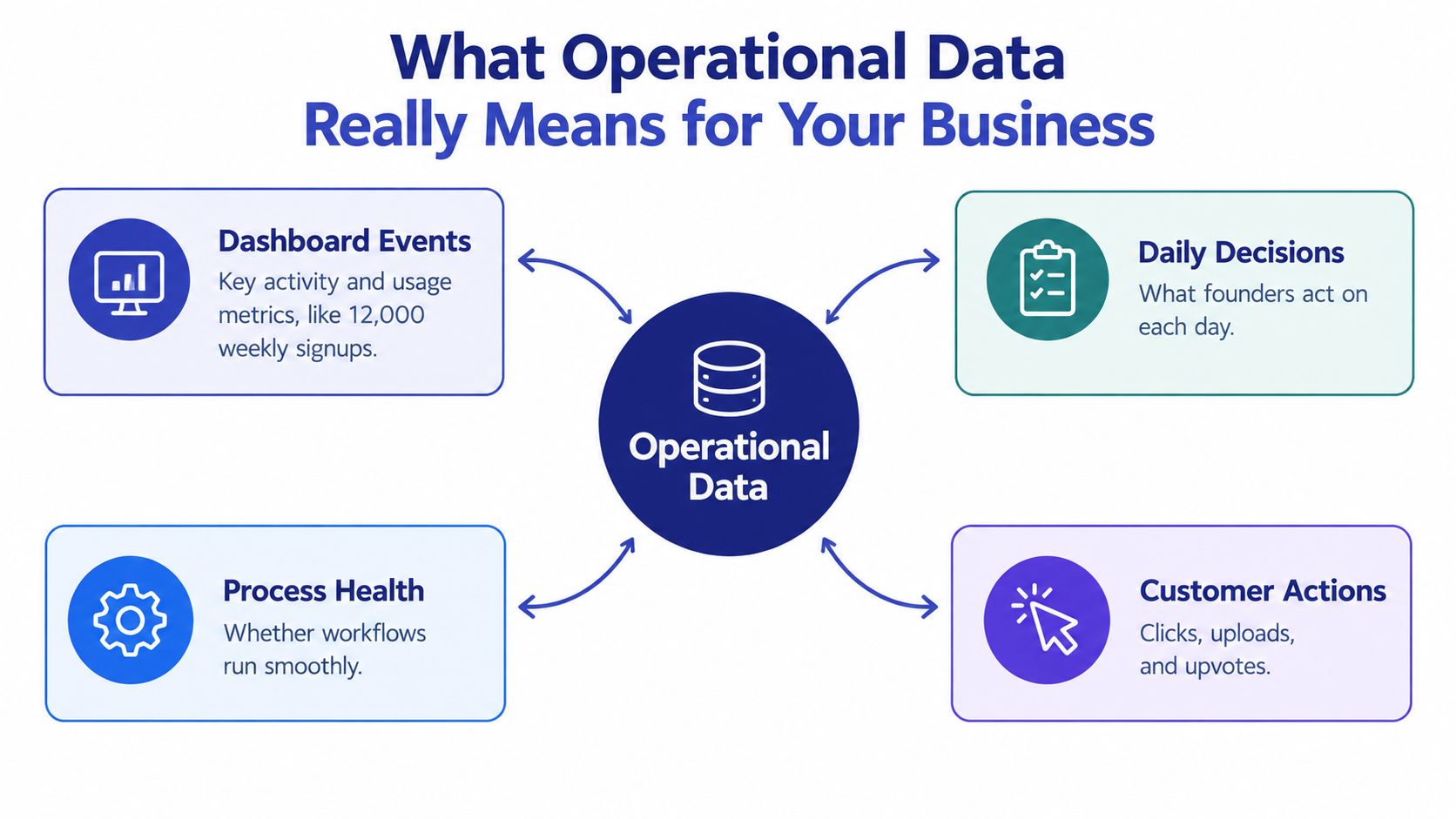
You may already be relying on operational data without calling it that. A founder opens a dashboard and sees 12,000 weekly votes, 200 signups, and a conversion figure that keeps changing. The team uses those numbers to decide which launch to promote, whether a campaign is working, and which customer needs attention next. If one event is missing, duplicated, delayed, or attached to the wrong project, the dashboard can look precise while pointing the team in the wrong direction.
The useful question isn't just where the data lives. It's whether the data is trustworthy enough for the decision in front of you right now.
What Operational Data Really Means for Your Business
Operational data comes directly from routine work, including transactions, customer interactions, production events, inventory movements, service requests, and workflow updates. IBM describes its value as fit for the specific process it supports, with quality dimensions such as accuracy, completeness, validity, consistency, uniqueness, and timeliness (IBM's overview of data quality).
For an AI product or SaaS platform, that means the events produced while people use the product. A launch page view, upvote, comment, referral event, backlink status update, or webhook delivery all qualify. Each record can influence what the system does next, whether that means updating a ranking, notifying a founder, sending a follow-up, or pausing a broken workflow.
Three tests for an operational record
Use three practical tests:
- Origin: Did the product, customer, or workflow generate the record directly?
- Use: Can a system or employee use it to influence the next action?
- Decay: Does its value fall when it becomes stale, incomplete, or disconnected from context?
A customer survey may inform product strategy, but it usually isn't operational data by itself. A quarterly cohort report may be valuable, but it has already been transformed for analysis. A project view captured during a live launch is operational because it records what happened and can affect promotion while the launch is still active.
The distinction matters because operational data supports execution, while analytical data supports interpretation. A report might tell you which acquisition source performed best over a period. An operational event can tell your application which referral just happened, whether the source was recorded, and whether the visitor reached a signup step.
| Trait | Operational Data | Transactional Data | Analytical Data |
|---|---|---|---|
| Main purpose | Keep a live process moving | Record a controlled exchange | Explain patterns and performance |
| Typical example | Vote event, webhook status, workflow update | Payment, account upgrade, billing record | Weekly conversion or SEO report |
| Time sensitivity | Often immediate or near real time | Immediate consistency is usually essential | May tolerate delayed ingestion |
| Main question | What is happening now? | What exchange must be recorded correctly? | What happened, and what does it suggest? |
| Trust concern | Can the next action rely on this event? | Is the record complete and consistent? | Are definitions, joins, and history stable? |
Trust starts with the decision
Don't assign one quality score to an entire dataset and assume the job is finished. A vote-counting process and a long-term SEO report have different requirements. The first may need strict uniqueness and near-complete event capture. The second may tolerate delayed updates if project identity and source attribution remain stable.
That decision-first approach gives your team a shared vocabulary. Instead of saying, “The dashboard data looks fine,” ask, “Is this specific metric accurate, complete, timely, and fit for the action we're about to take?”
How Operational Data Differs From Analytical and Transactional Data
The easiest way to separate the categories is to follow one event. A user clicks the upvote button on a launch page. That single action can appear in several forms across a product's data environment, but each form serves a different purpose.
Operational data captures the event and its live context. The application may need to update the project score, check eligibility for a ranking, refresh a founder dashboard, and place a message on a processing queue. The record is valuable because it helps the workflow continue.
Transactional data focuses on the durable exchange or account fact. If the event is tied to a paid upgrade, the transaction record needs stronger controls around identity, state, and consistency. In a simpler voting example, the account's recorded vote may be the durable fact that prevents an invalid repeat action.
Analytical data aggregates and reshapes the event. A warehouse may combine votes from many projects, join them to referral sources, and produce a weekly trend report. That version helps a growth team understand performance, but it isn't necessarily the right source for deciding whether the application should accept the next vote.
One event, three questions
The categories become clearer when you attach a question to each one:
- Operational: Has the upvote arrived, passed validation, and entered the ranking workflow?
- Transactional: Which account made the upvote, and what durable state should the system preserve?
- Analytical: How did voting volume vary by project, source, or period?
These questions may use related identifiers, but they shouldn't be answered by blindly querying the same table. An operational store is usually optimized for active application workflows. A transactional store protects important state changes. A warehouse or analytical layer organizes data for comparisons, trends, forecasting, and SEO measurement.
The same distinction applies to referrals. A live referral event helps attribute a current visit and trigger an action. A billing record documents a commercial exchange. A month-level acquisition report explains channel performance after events have been cleaned and grouped.
Practical rule: Store each fact where the decision needs it, but preserve a stable identity and lineage so the versions can still be reconciled.
Why mixing the categories causes trouble
When a founder uses an analytical table to power a live workflow, the application may act on delayed or transformed information. A ranking can lag behind real activity, or a notification can rely on a report that doesn't include the latest events.
The opposite mistake is also common. Teams ask an operational database to answer long historical questions through increasingly complex queries. That can make the product slower and produce inconsistent definitions as every dashboard calculates metrics differently.
A small team doesn't need three massive platforms on day one. It does need clear responsibility for each representation. Label the source of truth, the operational projection, and the analytical model. Then document which decisions may use each one and how quickly corrections must propagate.
The Core Quality Dimensions That Make Operational Data Trustworthy
A record can exist and still be unsafe to use. Trust comes from checking whether the record represents reality, contains what the decision needs, follows the expected rules, agrees with related systems, appears only once, and arrives soon enough.

Start with the quality questions
Accuracy asks whether the value reflects the event it describes. If a backlink monitor says a link is active when the page no longer contains it, the record is inaccurate. Check accuracy through targeted reconciliation, such as comparing a webhook status with the response received.
Completeness asks whether required fields and events are present. A referral event without its source, timestamp, project identity, or conversion outcome may be unusable for attribution. Define required fields in advance and reject or quarantine records that lack them.
Validity checks formats and business rules. A vote timestamp outside the expected range, an invalid project identifier, or a status value not recognized by the application should fail validation at capture rather than enter the dashboard.
Consistency means related systems agree where they should. If one service calls a project “published” while another calls it “live,” downstream workflows may split the same state into incompatible interpretations. Use shared definitions and versioned schemas.
Uniqueness prevents repeated records from looking like new activity. A duplicated vote can distort a ranking, while a replayed webhook can trigger the same workflow twice. Assign an event identifier and make downstream processing safely repeatable.
Timeliness measures whether data arrives soon enough for the decision. A stale backlink status may be acceptable in a historical SEO report but misleading when a founder is deciding which page to promote today.
For a launch platform, the right threshold depends on the action. A weekly ranking may require near-complete vote records and strict uniqueness. A long-term report may accept delayed ingestion if project identity and source attribution remain stable. NIST frames this as fitness for purpose, especially when information comes from multiple sources with uncertain provenance and lineage (NIST's data quality concept paper.pdf)).
A useful test is to write the decision beside the metric. Then list the minimum quality conditions that must hold before an automated action can run. If the conditions aren't measurable, the decision isn't ready for automation.
The following walkthrough shows how a team can inspect these conditions in practice.
For a concrete product example, examine the KPI Studio project page as a model for the kinds of metrics teams may expose to users. The important architectural question isn't how many metrics appear. It's whether each one has a definition, an owner, a freshness expectation, and a way to identify defects.
Architectures and Storage Patterns That Fit Early-Stage Teams
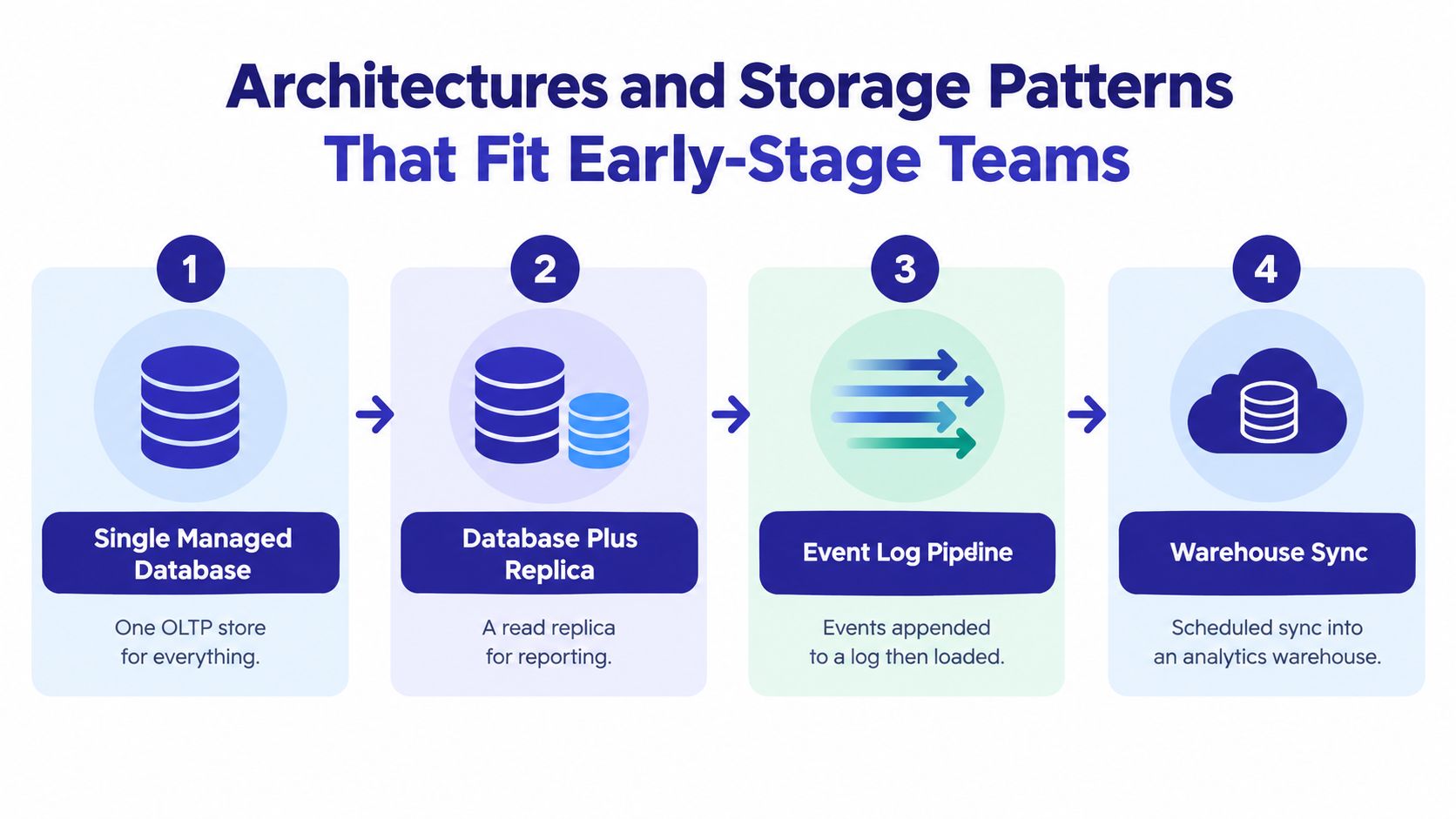
Early-stage teams often overcorrect in one of two directions. They either put every event into a single database and hope dashboards remain fast, or they build a complex streaming platform before they know which decisions require low latency.
Four workable patterns
Single managed database keeps product state, event records, and modest reporting in one managed OLTP system. It's the simplest option for a small product with one main writer. The trade-off is workload contention, especially when analytical queries grow.
Database plus replica separates application reads from reporting reads. A read replica can reduce pressure on the primary system, but it doesn't solve every freshness or transformation problem. Replication delay also becomes a quality condition that your dashboards need to understand.
OLTP plus event stream appends important events to a durable log after the application accepts them. Consumers can update rankings, notifications, search indexes, or analytics independently. This pattern fits teams with several systems writing or consuming launch events, votes, referrals, and social signals.
Warehouse-first treats the product database as the operational source of truth and regularly synchronizes selected records into a warehouse. It works well when the product remains relatively small but the team needs serious reporting, experimentation, or SEO analysis.
A lakehouse-style design can unify raw events and transformed tables, but it brings more governance and operational burden. It makes sense when the team has reached a stage where multiple workloads require shared historical data, not because the label sounds modern.
Choose by failure cost
Use a simple decision rule:
- One product, one main workflow: Start with a managed OLTP database and clear event tables.
- Multiple writers or live consumers: Add an event stream when handoffs and retries become difficult to manage.
- Heavy analytics with a modest product surface: Sync into a warehouse while keeping operational state in the product database.
- Many data products and AI workloads: Consider a lakehouse only when the organization can support lineage, access controls, schema evolution, and monitoring.
The Audax Data Manager project illustrates the type of operational problem that often prompts this discussion, but no product page can replace an architecture decision based on your own event flows.
For AI workloads, preserve raw context before aggressive transformation. Ranking needs current signals. Retrieval needs stable identifiers and useful text. Analytics needs consistent dimensions. A single event pipeline can support all three only if the team records the event contract, processing state, and lineage.
How SourceX Can Help
Operational data is valuable inside a company, but some organizations also consider licensing carefully prepared datasets to AI labs and other data buyers. That introduces a different trust problem. The supplier must show where the records came from, what rights apply, how privacy was handled, and what the buyer is allowed to do with the delivered material.
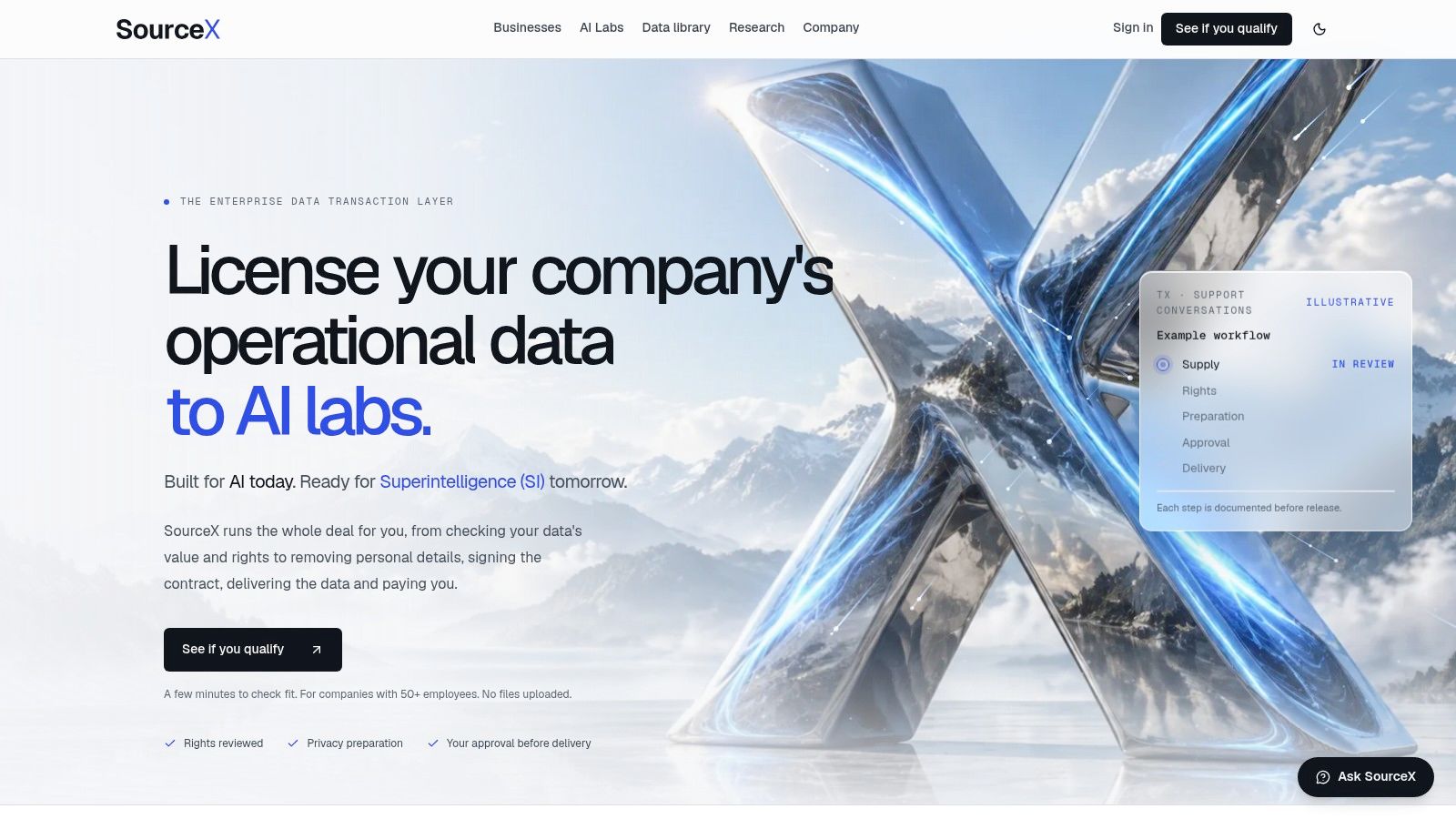
SourceX operates as an enterprise data transaction layer for that workflow. It supports fit assessment without requiring an immediate upload, structured mapping across business systems and historical records, private inventory creation, rights review, provenance confirmation, deidentification, pricing, contracting, delivery, and payment. Its stated compatibility includes exports from systems such as Zendesk, Salesforce, GitHub, Jira, SharePoint, and Google Workspace.
Where the model fits
SourceX is most relevant when your organization has potentially useful operational records but lacks a repeatable process for turning them into a rights-cleared dataset. Its controls are designed around supplier authorization, with nothing shared until explicit approval. A preparation evidence packet can document the system of origin, licensing rights, intended purpose, deidentification steps, and usage constraints.
That matters because operational data often contains customer, employee, support, engineering, or document information. Dataset-specific preparation is safer than assuming one anonymization recipe fits every source. The supplier also needs to confirm lawful collection and define the permitted scope before release.
The platform can help buyers evaluate inventory by source, depth, fields, and availability rather than receiving an opaque export. It can also standardize selection windows, licensing terms, agreements, and delivery coordination. Those features solve coordination and provenance problems, not the underlying question of whether a particular dataset is strategically valuable.
If licensing is part of your plan, the SourceX operational data licensing resource is a useful place to examine the workflow in detail. It's the right choice when rights validation, privacy preparation, and supplier-controlled release are central requirements. It's not a substitute for internal governance, and it won't make a dataset suitable for a buyer if the source records lack useful context or stable definitions.
Choosing the Right Latency for Each Operational Decision
Your team is about to trigger an action. Approve a paid upgrade, refresh a launch ranking, or alert someone to a broken backlink. The central question is not whether the system can update in real time. It is whether the data is trustworthy enough, soon enough, for that specific decision.
Some decisions age badly within seconds. A fraud screen on a payment event may need an immediate answer because waiting creates direct risk. Other decisions have a wider safe window. A launch ranking needs current votes before publication, but it may not need a full recalculation after every event. A backlink health report can usually refresh more slowly, as long as users know the reporting window and can judge the output accordingly.
Match speed to consequence
A simple way to choose latency is to sort decisions into four operating classes:
- Instant: Use this when delay can allow fraud, duplicate action, or an unsafe state change.
- Near real time: Use this when a person or automated workflow needs fresh data within a short operating window.
- Hourly batch: Use this for rankings, campaign checks, or queue summaries where a brief delay does not change the decision.
- Daily batch: Use this for slower SEO, historical, or governance reporting where context and stability matter more than immediacy.
Let the consequence of waiting drive the choice rather than the wish to look advanced. Analysts at Omdia found that real-time analytics was a priority for 82% of IoT enterprises in research covering more than 600 enterprises across ten countries (Omdia's real-time analytics research). That demand for speed is real. It still does not guarantee that a team has enough context, lineage, and quality control to act safely the moment data arrives.
Here is the practical test. If a slower pipeline gives you complete attribution, stable definitions, and an owner who can investigate anomalies, that pipeline may be more decision-ready than a faster one with gaps.
Write an operating envelope
For every automated decision, document four conditions:
- Acceptable delay: How old can the data be before the action becomes unsafe?
- Confidence threshold: What quality or confidence level must the system meet?
- Rollback rule: What happens when a later correction invalidates the action?
- Escalation owner: Which person or team handles an unresolved incident?
This operating envelope works like a safety label on machinery. It tells everyone when the system is safe to use, when to slow down, and when to stop. An hourly process with reliable lineage can support a better SEO choice than a near-real-time feed nobody can explain.
Privacy, residency, and auditability belong in the same decision. Streaming customer or location events can create obligations that do not disappear because a dashboard wants fresher numbers. Aim for the fastest data you can trust and defend.
Operational Observability The Discipline Behind Trustworthy Data
Data quality asks whether a value is suitable for a task. Data observability asks whether the environment producing that value remains reliable and diagnosable. A successful pipeline job doesn't prove that the right records arrived, that a vendor kept its schema stable, or that a downstream metric still has the same meaning.
Monte Carlo's data observability material describes five useful monitoring areas: freshness, volume, quality, schema, and lineage (the data observability reference).
Five signals, five failure modes
Freshness detects late or stalled delivery. If weekly launch votes stop arriving before rankings are finalized, the system should raise an incident rather than publish an incomplete result without warning.
Volume detects abnormal drops and spikes. A sharp fall in homepage impressions may indicate a real audience change, but it may also mean an analytics integration stopped sending events.
Quality tests values and business rules. An invalid timestamp, unknown project identifier, or impossible status should be visible as a defect, not buried inside a successful job.
Schema catches breaking changes. If an analytics vendor renames a campaign or referral field, a schema check can stop the affected transformation before it corrupts reports.
Lineage shows which upstream source caused a downstream metric to change. Without lineage, an owner sees a changed dashboard number but has no reliable path back to the event, table, or vendor responsible.
A good alert contains more than “pipeline failed.” Include the affected tables or events, the last known good timestamp, downstream dashboards, and a named owner. That context turns detection into recovery.
A week-one implementation
Start small:
- Create a contract for each important event, including its name, required fields, identifier, timestamp, producer, and allowed values.
- Assign one owner to every metric shown to customers, founders, or operators.
- Add capture-time validation and quarantine invalid records instead of dropping them without notice.
- Track freshness and volume for the events behind the most important decision.
- Record lineage from source through transformation to dashboard.
- Test one failure deliberately, then document the response.
A webhook and scheduled-job monitoring pattern, such as the one represented by Hookwatch unified monitoring, can help teams make delivery health visible across different workflow types. The principle is more important than the tool. Owners should know when data stopped arriving, what decisions are affected, and how to restore confidence.
Best Practices Governance Contracts and a Founder Implementation Checklist
Governance for a small team shouldn't begin with a committee or a large policy library. It should begin with the events and metrics that can change a customer experience, ranking, payment state, or automated action.
A data contract makes an event's expectations explicit. It defines the event name, required fields, identifier rules, timestamp behavior, valid values, owner, privacy classification, and schema version. The contract also states what should happen when a producer sends an invalid record.
Ten checks for the first week
| Check | Failure it prevents |
|---|---|
| Name events consistently | Conflicting definitions across services |
| Define required fields | Incomplete attribution or workflow records |
| Add stable event identifiers | Duplicate votes and replayed webhooks |
| Version schemas | Silent breaking changes |
| Assign a metric owner | Unresolved dashboard incidents |
| Set freshness targets | Decisions based on stale data |
| Validate at capture | Bad values spreading downstream |
| Quarantine invalid records | Defects disappearing without review |
| Document privacy and retention | Uncontrolled exposure of sensitive records |
| Add rollback rules | Automated actions surviving corrected data |
Keep the checklist close to the code and the dashboard. A contract that nobody checks becomes documentation theater. Capture-time validation, structured error handling, and visible ownership make the contract operational.
Design principle: Don't silently drop bad records. Preserve enough information to investigate them, while keeping them out of decision paths until someone resolves the defect.
Review defect rates on a regular cadence that fits your team. A small group might begin with a weekly review of missing fields, duplicate identifiers, late events, schema changes, and unresolved incidents. The purpose isn't to create a perfect dataset. It's to see whether the decisions that matter have dependable evidence.
Two mistakes deserve special attention. First, teams build attractive dashboards before defining the metrics behind them. Second, they chase streaming infrastructure before they can detect when the stream is late, duplicated, or malformed. A modest architecture with contracts and observability is safer than a complex architecture with no explanation for its numbers.
Start with one decision. Define its event contract, set its acceptable freshness, name its owner, and add an alert. Then expand only when that loop works.
Putting Operational Data to Work Building Trust Before Scale
Operational data maturity isn't measured by the number of dashboards or pipelines your team has shipped. It's measured by how confidently someone can answer, “Can we act on this number right now?”
The answer depends on fit-for-purpose quality, latency matched to the decision, observability across freshness and lineage, and governance through contracts and named owners. You don't need to redesign the entire data platform to begin.
Choose one decision that matters this week. Define the records behind it, set a freshness target, add one meaningful alert, and assign one person to respond when the evidence breaks. Once that loop is reliable, apply the same discipline to the next decision.
If you're preparing an AI product launch and want a structured way to capture launch events, votes, referrals, backlinks, and performance signals, submit your project to EarlyHunt. Use the launch process to test not only visibility, but also whether your operational data can support trustworthy decisions while the moment still matters.